




Most sustainability initiatives don’t involve a road trip and a vintage bus, but every summer for the last 10 years, Jim Denevan — an artist, chef and, now, cookbook author from Santa Cruz, Calif. — has gathered friends into a big 1953 Flxible bus and headed out across North America to show diners where their food comes from. His project, Outstanding in the Field, works with local farmers and chefs to turn farm fields around the country into vast outdoor restaurants.
These dinners are big: 100 guests typically sitting at a huge table set at the edge of an asparagus patch, on a hill in a sheep pasture or near a working barn. Why eat dinner in a farm field? Because it’s the most literal way to connect people with their food. See that rainbow chard tart? The chard came from this field right here — yeah, the ground where that robin is pulling at a worm.
People love this idea. In fact, like dozens of other Outstanding in the Field events, the dinner held last August near the Twin Cities sold out so quickly that I couldn’t even get a ticket. I later heard from my chef friends who attended that it was a profoundly beautiful and moving event: wind in the hills, dairy cows and wildflowers, fireflies and stars instead of dinner mints and credit-card receipts.
Denevan’s book, Outstanding in the Field: A Farm to Table Cookbook (Clarkson Potter, 2008), presents his favorite dishes, gleaned from his decade of farm dinners (the first was thrown in 1999). The recipes are very simple, which makes sense — they’re all prepared in an outdoor kitchen.
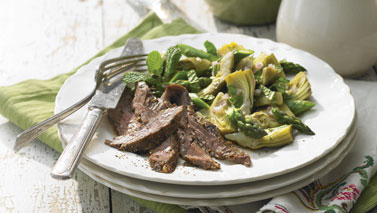
Skirt steak, for example, is grilled and coupled with a simple artichoke and asparagus salad (see Web Extra! at right). Young dandelion greens are wilted and paired with a dressing made with a little cured pancetta and a poached egg. Wild mussels are steamed with nothing but a shallot, white wine and sea beans, a plant that grows wild in brackish water near the seaside (if you don’t have any sea beans, spinach will do).
The simplicity of these meals really brought home for me how much contemporary cooking relies on fancy technology like food processors or exotic ingredients like rare vinegars.
It’s a paradox Denevan explores in his book. “Interestingly, whenever I am approached to discuss either my art or the dinners, the questions and the conclusions drawn by the questioner inevitably return to the alleged novelty of both,” he writes. “But although Outstanding in the Field appears unusual, in fact, celebrating the harvest is something we humans did with absolute regularity until fairly recently. What seems exciting now — sharing the bounty of freshly picked ripe food with a community of people — was commonplace before the dawn of industrialized agriculture.”
That idea suddenly struck me: Sustainable lifestyles, knowing where your food came from, eating seasonally — these were everyday things that people did until sometime after World War II. How odd that this is now considered almost revolutionary.
Denevan isn’t one to limit his palate by location or season, though: “Capers, anchovies, tomato paste and lemons are all staples in my cooking,” he writes. “The goal is to build a tasty, satisfying meal primarily with what is local and seasonal, supplementing with ingredients from farther afield. The reality is that it’s tricky to eat strictly locally and seasonally all the time, but that doesn’t mean we shouldn’t try to find a good deal of our foods from close to home when possible.”
When we do find those close-to-home foods, it may be nice to re-create a bit of Outstanding in the Field in our own lives and take some time to consider where those foods were grown — amid pasture breezes, robins and worms, with fireflies and stars lighting the night sky.
Grass Fed Beef Skirt Steak
Serves four
- 4 (8 oz.) skirt steaks
- Kosher salt
- Freshly ground black pepper
Directions
- Prepare the grill so the coals are glowing red but no flame is visible. Trim any excess fat from the steaks and season them with salt and pepper.
- Grill for two to four minutes on each side, depending on their thickness, for medium rare. Set the steaks aside on a warm plate to rest.
- Slice the steaks against the grain and on a slant. Arrange the slices of meat on the plates with the artichoke and asparagus salad (below), pouring any juices on top, and serve.
Artichoke and Asparagus Salad
Serves four
- 3 lemons
- 1 pound small artichokes
- 1/4 cup white wine vinegar
- 2 fresh or dried bay leaves
- Kosher salt
- 8 ounces thin to medium asparagus
- 1 small shallot, minced
- 1/2 cup extra-virgin olive oil, plus more for serving
- 4 sprigs mint
Directions
- Fill a large bowl with cold water. Cut two of the lemons in half and juice them into the water, tossing in the lemon rinds as well. Remove the outer tough leaves from each of the artichokes so only the tender, light yellow leaves are showing. Using a paring knife, trim the bottom and peel the green outer layer from the stem. Trim the top 1 inch from each artichoke. Put each artichoke in the acidulated water as soon as you’re finished.
- When all the artichokes have been trimmed, cut them in half lengthwise and use a spoon to scoop out the furry choke and tiniest pinkish leaves. Place the cleaned artichokes in a medium saucepan and cover with cold water. Add the vinegar, bay leaves and about 1 1/2 tablespoons salt; the water should be just slightly less salty than the sea. Place a piece of parchment paper cut to fit just inside the pan over the artichokes; press it down so it touches the water. Bring to a boil over medium-high heat. Reduce the heat and simmer until the artichokes can be easily pierced through the heart with knife, about 30 minutes. Remove the pot from the heat, remove the parchment paper from the pan, and let cool completely.
- Bring a pot of salted water to a boil and prepare a bowl of ice water. Snap the fibrous ends off the asparagus. Add the asparagus to the boiling water and cook until slightly tender but still with good bite, about one minute. Drain the asparagus and plunge it into the ice water to stop the cooking and retain the green color. When cool, dry the asparagus on a clean kitchen towel. Cut on a slant into 1 1/2-inch pieces. Set aside.
- Juice the remaining lemon and mix with the shallot in a small bowl. Set aside to macerate for 10 minutes. Add a pinch of salt and, whisking constantly, slowly pour in the olive oil. Set the dressing aside.
- Remove the artichokes from their cooking liquid and slice them lengthwise from top to stem. Combine the sliced artichokes and the asparagus in a medium bowl and set aside.
- Strip the leaves of mint from the stems and coarsely chop the leaves. Put them in the bowl of artichokes and asparagus. Add the dressing and toss slightly to combine. Season to taste with salt and pepper.
- Arrange the salad on four plates. Drizzle with olive oil and serve.
Blueberry Granita
Serves four to six
- 3 1/2 cups fresh blueberries
- 1/2 cup superfine sugar
- 1 tsp. grated lemon zest
- 1 tbs. fresh lemon juice
- Crème fraîche or unsweetened whip cream, for serving
Directions
- Combine 2 1/2 cups of the blueberries and the sugar in a food processor and blend until very smooth. Strain the puree through a fine mesh strainer, using a wooden spoon to help press out all the juice. Discard any remaining solids.
- Add 3/4 cup water, the lemon zest and juice to the blueberry purée. Pour the mixture into a shallow nonreactive pie plate, baking dish or tray. Place the dish in the freezer and stir every hour with a fork, crushing and scraping the ice forms. When the mixture is evenly frozen and icy, after about four hours, scrape once again to fluff and lighten the crystals.
- Spoon the granita into chilled glasses and top with remaining 1 cup fresh blueberries and a dollop of crème fraîche. Serve immediately.
Recipes excerpted from Outstanding in the Field: A Farm to Table Cookbook by Jim Denevan (Clarkson Potter, 2008).
This article originally appeared as “Land of Plenty.”
This Post Has 0 Comments