




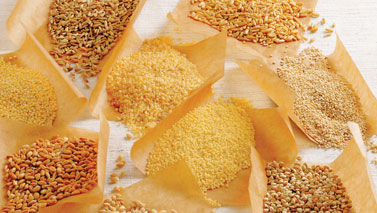
Think “whole grains,” and the usual suspects spring to mind: the whole-wheat bread you had in your sandwich yesterday or the bowl of oatmeal you ate for breakfast today. Kinda boring, huh?
Let’s face it — even if these whole-grain standbys aren’t totally played out in your book, they’re not exactly exciting. Some health experts also argue that we’ve been dangerously overexposed to wheat, in particular, because it’s become so ubiquitous in the foods we eat every day (think bread, pastries, pizza, pasta and cereal, to name just a few).
Besides, if wheat and oats are the only whole grains you’re eating, you’re missing out on a whole world of wonderful grains out there, many of which offer sensory, culinary and nutritional advantages that your old favorites can’t begin to match.
Why ignore the nutty goodness of buckwheat, the delicate texture of millet, the heady perfume of pigmented rice, the earthy satisfaction of rye and the mellow softness of barley? And why miss out on their health benefits?
Many of these so-called ancient grains are easier to digest, slower to raise blood sugar, and denser in the fiber and phytonutrients your body uses to ward off many chronic diseases, including cancer.
“Wheat is lower in fiber than both rye and barley,” says Leonard Marquart, PhD, RD, a food science and nutrition professor at the University of Minnesota in Minneapolis. “There are also a variety of other compounds in less conventional whole grains that you don’t get in wheat, such as antioxidants that are much more powerful than vitamin C in protecting your body from free-radical formation.”
Another reason to expand your whole-grain repertoire? You’ll have more ways of avoiding gluten, a potentially irritating protein found in wheat and many other grains (read on for an overview of both gluten-free and gluten-containing whole grains).
“About 3 million Americans suffer from celiac disease and can’t have any gluten,” says Carol Fenster, PhD, author of eight cookbooks on gluten-free cuisine. People with celiac disease can experience digestive distress, joint pain, inflammation or skin problems when they eat gluten. Some experts believe that an additional 35 to 50 percent of the U.S. population is gluten-sensitive.
In their book, Dangerous Grains: Why Gluten Cereal Grains May Be Hazardous to Your Health, authors James Braly, MD, and Ron Hoggan, MA, experts in celiac disease and food allergies, make the case for cutting back on grains and eating more like our hunter-gatherer ancestors who thrived on fish, meat, fruits and vegetables for more than a million years before farming and grain cultivation were introduced.
Fenster recommends that anyone cutting back on gluten try to eat a wide variety of legumes, vegetables and non-gluten whole grains, rather than fill up on starchy, high-glycemic foods such as white rice and potatoes, or gluten-free flours made mostly of nutrient-poor refined starches.
Ready to expand your whole-grain horizons? Start by trying one or more of the five grains outlined on the next page. Most are available in the natural-foods section of many markets and can be stored in the refrigerator or freezer for up to a year. For an even wider range of grain options, see “The World of Grains” below.
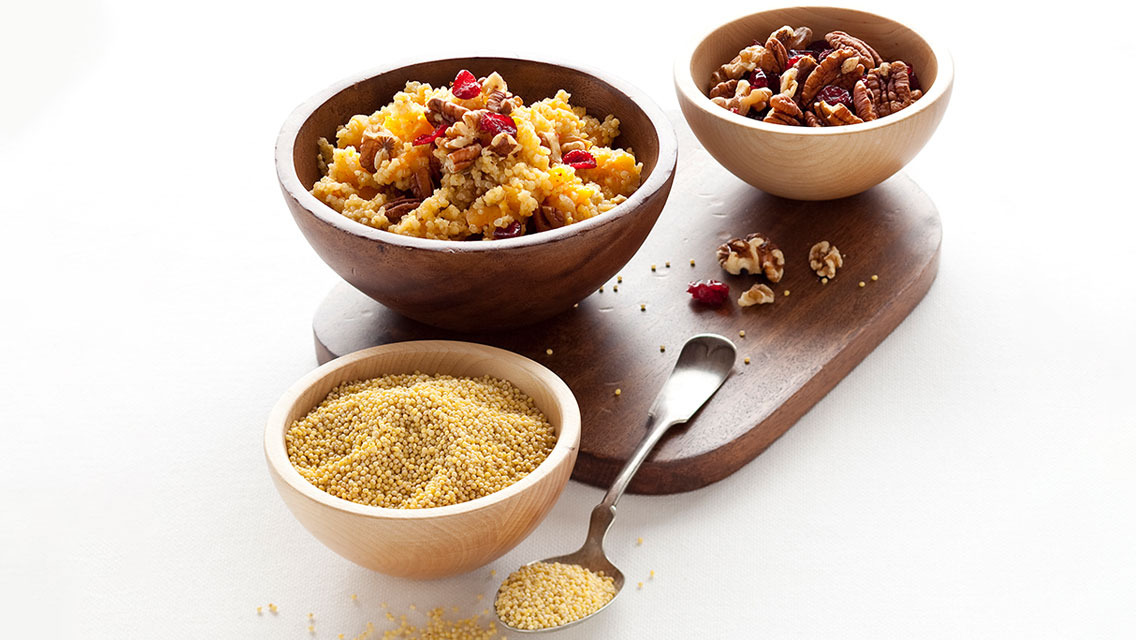
1. Millet
The tiny, round yellow seeds you see in birdseed mixes may not look like much, but back in 2700 BC, millet was the life-saving grain for peasants in northern China, Africa and India.
Health benefits: The diminutive yellow grain is still a lifesaver. A cup provides a wealth of magnesium, which lowers blood pressure and reduces the risk of heart disease as well as the severity of asthma and migraines. It’s also rich in phosphorus, which is essential to bones, energy and lipid metabolism. Millet is also high in manganese and lysine, an essential amino acid.
Contains gluten? No.
How-to: Toast or sauté in a dry, hot pan, and add hot water or stock in a ratio of 21⁄2 cups of liquid to 1 cup of millet for a fluffy, separate grain. Or, cook 1 cup of millet in 3 cups of water for a soft, golden porridge. Millet cooks in 20 to 25 minutes and is great in soups, pilafs, cereals and stir-fries; if you go the porridge route, you can chill millet and slice it like polenta.
2. Rye
Origin: If you’ve ever tasted rye bread, you already know the hearty, almost spicy flavor of rye. One of the world’s hardier grains, rye grows even in poor soils. Its gluten content made it a great bread flour for Northern European bakers who kneaded it into classic yeasted loaves. The majority of the rye we eat today is still grown in Northern Europe.
Health benefits: Rye is blessed with a higher fiber content and more antioxidants than wheat, says Marquart. “Rye also contains more of a kind of starch called arabinoxylans that may lower blood glucose,” he adds, noting that those starches also absorb more water than other kinds, creating bulk and a feeling of fullness.
Contains gluten? Yes.
How-to: Soak the grains overnight. Simmer 1 cup of rye in 2 cups of water until tender, about 45 minutes to an hour, and drain. Use rye in salads, soups and anywhere a zingy, crunchy grain is appropriate. Finding whole rye berries is tricky, so you may have to order online. (For these and all other whole grains mentioned in this article, a great source is Bob’s Red Mill Natural Foods: www.bobsredmill.com.)
3. Barley
Origin: Barley is thought to be the first cereal grain ever domesticated, somewhere in Southeast Asia. It was the primary grain of ancient Sumer, Babylon, Egypt and the Mediterranean. Roman gladiators ate a porridge of barley, roasted flaxseeds and coriander, ingredients you might see in a healthy hot cereal today.
Health benefits: Most of the barley you see on store shelves is pearled barley, which is not a whole grain (it does, however, contain beneficial soluble fibers called pentosans and beta-glucans that lower cholesterol). Ask for unrefined hulled barley, sometimes called “naked barley,” a variety that still has the bran and germ intact. Barley is lowest on the glycemic index of the grains, providing slow-acting, longer-lasting energy.
Contains gluten? Yes.
How-to: Whole, hulled barley is a good grain to soak overnight, simmer in plenty of water or broth (1 cup of barley to 2 1/2 cups of liquid), and then drain or eat as soup. Whole, hulled barley that has been soaked cooks in 45 minutes to an hour and has a tender interior and crunchy bran layer (barley that has not been soaked may need to cook for up to 90 minutes). Barley adds a great texture to soups, salads and pilafs.
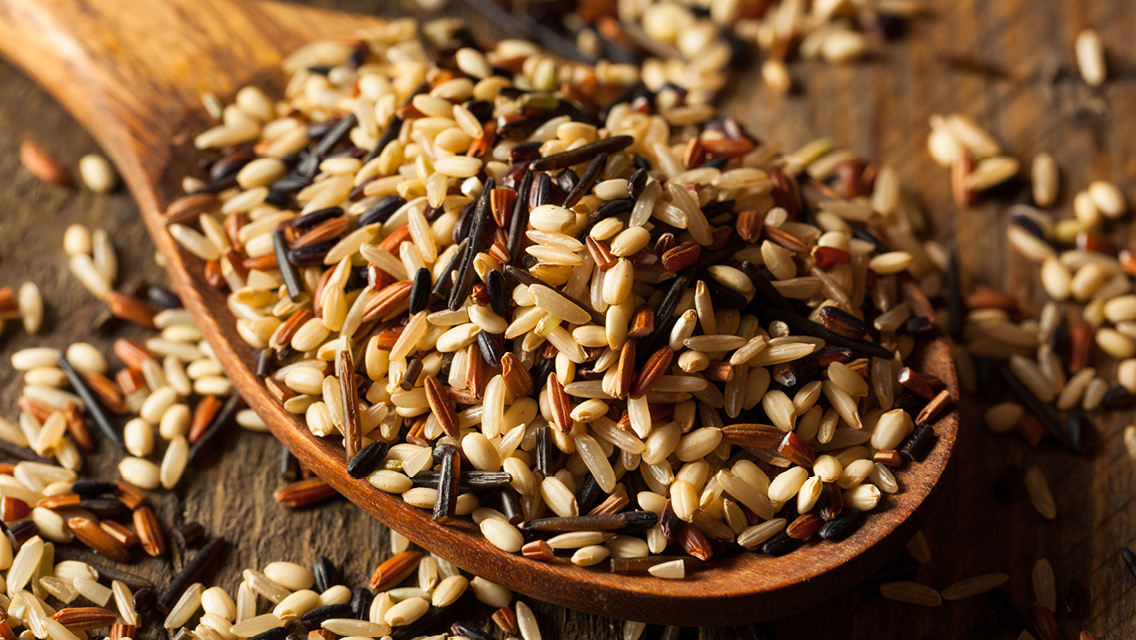
4. Pigmented Rice
Origin: There are more than 100,000 varieties of rice grown throughout the world, and many of them are red, black, purple, mahogany, even greenish.
Health benefits: The rich colors of these rices are a sign of their vast health benefits, says Marquart: “The darker the color of a grain, the richer it tends to be in phenolic content and antioxidant activity.”
Contains gluten? No.
How-to: The colored rices come in long, short and sweet varieties. Generally, longer grains need a little more water and come out firmer, while shorter and sweet rices are very tender. The various rices generally take 11⁄2 to 21⁄2 cups of liquid per cup of rice, and cooking times range from 25 minutes to an hour, depending on the variety. All rice is gluten-free, even “glutinous” rice. “The dark rices are so substantial,” says Fenster. “I cook the black rice in coconut milk and put coconut and mangoes on top. I’m addicted to it as a dessert.”
5. Buckwheat
Origin: Buckwheat is related to rhubarb and sorrel and is not really a grain, but the fruit seeds are cooked and eaten like grains, so we think of them as one. Domesticated in Central Asia 1,000 years ago, it landed in Northern Europe in the Middle Ages.
Health benefits: Buckwheat contains a phytochemical called rutin, which acts as an anti-inflammatory in the body, says Marquart. “Buckwheat might also be associated with a lowered risk of diabetes,” he says.
Contains gluten? No.
How-to: Like millet, buckwheat is often dry-toasted or sautéed before liquids are added, both to keep it from falling apart and to give it a nutty taste. (Toasted buckwheat is sold as kasha.) Cook 1 cup of buckwheat to 11⁄2 cups of liquid for a firm version; for a softer grain, use a 1-to-2 ratio. Buckwheat makes a hearty pilaf and is great in stuffed cabbage.
List of Gluten-Free Grains
Amaranth: Tiny seeds loaded with trace minerals, amaranth makes a tasty porridge with crunchy bits. Great in hot cereal, as a polenta substitute or ground up to make flour in gluten-free baking. Gluten-free.
Barley: Look beyond pearled for hulled purple, bronze and golden barley. As cholesterol-lowering as oats and containing more protein, barley is great in soups, salads, pilafs or as a cereal. It’s also low in gluten. Contains gluten.
Buckwheat: Many “buckwheat” pancake mixes contain only a little buckwheat and are mostly white flour (same with soba noodles), so check the label. Try toasted buckwheat (kasha) for a robust taste, or cream of buckwheat cereal for a mild one. Gluten-free.
Corn: Popcorn, cornmeal, polenta, grits, masa, hominy and dried whole sweet corn are all whole grains. Southern specialties like grits and hominy can be healthful options (as long as you hold off on the fat when preparing them). Also, look for organic brands: The vast majority of the corn sold on U.S. shelves is genetically modified and grown with chemical fertilizers and pesticides that pollute the water and are hard on the soil. Gluten-free.
Job’s Tears (a.k.a. hato mugi): Sometimes called Chinese barley, but unrelated to barley, Job’s tears is a fat, chestnutty-tasting grain found in the macrobiotic section of natural-foods stores. Only the least pearled hato mugi, Yuuki, is complete, meaning its bran and germ are intact. Gluten-free.
Millet: Mild-tasting millet is great cooked in broth for pilafs or simmered in milk-like rice pudding. When soft-cooked, it makes a good binder for veggie croquettes or burgers. You can also scramble millet with eggs for breakfast. Gluten-free.
Quinoa: The Incan “mother grain,” quinoa is quick cooking, with nutty-tasting orbs. It has the distinction of staying separate no matter how you cook it, so it’s great in fluffy 15-minute pilafs. It pairs well with south-of-the-border flavors like lime, cilantro, jalapeño and chipotle. (For more on quinoa, see “Quinoa”.) Gluten-free.
Rice: Short-grain rices — brown or colored — are best for sushi, risotto and puddings, while longer-grain rice is great in pilafs or with a stir-fry or curry. Wild rice is actually a grass, not a rice; opt for the hand-harvested version over the shiny black cultivated rice, which takes twice as long to cook. Gluten-free.
Other Alternative Grains
Oats: Beyond oatmeal, try using steel-cut oats to make tabbouleh or in breads for a chewy texture. Whole-oat groats make a chewy, sweet kernel that is wonderful in soups and salads. Oats are considered a gluten risk because other glutinous grains often are grown in the fields with them, but certain steel-cut oats are certified gluten-free. Contains gluten — sometimes.
Rye and Triticale: Rye breads are a great way to get the benefits of this tasty grain, as long as you look for whole-grain loaves. Triticale was created by crossing wheat and rye to get a more complete protein; although it never really caught on, triticale is very high in protein. Contains gluten.
Wheat, spelt, kamut, farro, bulgar, couscous: All of these are members of the wheat family. Bulgar is a chopped, presteamed whole-wheat product that makes a great pilaf or tabbouleh base. Whole-wheat couscous is a tiny pasta-like granule that cooks in five minutes, absorbing hot liquids as it stands. Contains gluten.
Crunchy Farro Salad With Artichokes, Red Bell Peppers and Edamame
Wheat, like rice, has different varieties with differing starch balances. The first cultivated wheat, called einkorn, is ten thousand years old and is still grown today. It crossbred with a wild grass to create emmer (or farro) and durum wheats. A few thousand more years passed before another chance crossbreeding created today’s common bread wheat, as well as spelt and club wheat. If you can’t get farro or spelt berries, whole hard winter wheat berries will work, as will hulled barley or whole oats.
- 1 cup farro or wheat berries
- 2 1/2 cups vegetable stock
- 1 sprig rosemary
- 1/2 tsp. plus a pinch of salt, divided, or to taste
- 2 gloves garlic, peeled
- 2 ounces fresh basil (1 1/2 cups leaves)
- 1/4 cup pine nuts
- 2 tbs. lemon juice
- 1/4 cup extra-virgin olive oil
- 12 baby artichokes or one 13-ounce jar artichoke bottoms, drained
- 1/2 large lemon (if using fresh artichokes)
- 1 small red bell pepper, sliced
- 1 cup shelled edamame, thawed
- Freshly cracked black pepper
Directions
- In a small, heavy saucepan, dry-toast the farro over high heat until hot and lightly fragrant. Add the vegetable stock, rosemary and a pinch of salt. Bring to a boil, reduce the heat to a simmer, and cover. Cook for about an hour, until tender. Drain any excess stock and cool to room temperature.
- Put the garlic, basil and pine nuts in the work bowl of a food processor and process to chop very finely. Add the remaining 1/2-teaspoon salt and lemon juice and process until smooth. Gradually add the olive oil to make a smooth paste.
- Trim and halve the baby artichokes and put in a large bowl of cold water with half of the lemon. Bring a large pot of water to a boil, drain the artichokes, and boil them until a knife inserted into an artichoke enters easily.
- In a serving bowl, toss the cooked grain, dressing, artichokes, bell pepper and edamame. Crack black pepper over the salad and serve.
Buckwheat and Broccoli Salad in Tangy Miso Dressing
The dark flavor of buckwheat gives this salad a range of tastes, from the deep, nutty grains to the tangy, sweet dressing. Brown and pigmented rices, wheat berries, and other grains are equally good with the miso dressing.
- 1 cup buckwheat groats
- 1 1/2 cups water
- 2 tbs. red miso
- 1 tbs. canola oil
- 1 tbs. rice vinegar
- 1 tbs. dark sesame oil
- 1 tbs. grated ginger
- 1 clove garlic, minced or crushed
- 1/4 tsp. red pepper flakes
- 1 tbs. honey
- 2 cups broccoli florets, blanched
- 1/2 cup julienned carrot
- 2 scallions, minced
- 1/2 cup cashews, toasted
Directions
- In a small, heavy saucepan, heat the buckwheat groats over medium-high heat. Swirl the groats in the pan, toasting them until they are crackling, hot to the touch and fragrant, about five minutes.
- In a wire-mesh strainer, wash the hot buckwheat quickly and drain thoroughly. Put the 1 1/2 cups water in the pan and bring to a boil. Add the buckwheat, return to a boil, cover tightly, and reduce the heat to the lowest setting. Cook for about 20 minutes, until all the liquid is absorbed.
- Take the pan off the heat and let stand for five minutes, then transfer the cooked grain to a bowl, cover, and let cool to room temperature. In a large measuring cup, whisk the miso, canola oil and vinegar until smooth. Whisk in the sesame oil, ginger, garlic, pepper flakes and honey. Pour the dressing over the cooled buckwheat and toss to coat.
- To serve, spread the buckwheat on a platter, and top with the broccoli, carrot and scallions. Sprinkle the cashews over the salad and serve.
- Alternatively, mix the veggies into the grain and chill.
Crunchy Farro Salad With Artichokes, Red Bell Peppers and Edamame
Wheat, like rice, has different varieties with differing starch balances. The first cultivated wheat, called einkorn, is ten thousand years old and is still grown today. It crossbred with a wild grass to create emmer (or farro) and durum wheats. A few thousand more years passed before another chance crossbreeding created today’s common bread wheat, as well as spelt and club wheat. If you can’t get farro or spelt berries, whole hard winter wheat berries will work, as will hulled barley or whole oats.
- 1 cup farro or wheat berries
- 2 1/2 cups vegetable stock
- 1 sprig rosemary
- 1/2 tsp. plus a pinch of salt, divided, or to taste
- 2 gloves garlic, peeled
- 2 ounces fresh basil (1 1/2 cups leaves)
- 1/4 cup pine nuts
- 2 tbs. lemon juice
- 1/4 cup extra-virgin olive oil
- 12 baby artichokes or one 13-ounce jar artichoke bottoms, drained
- 1/2 large lemon (if using fresh artichokes)
- 1 small red bell pepper, sliced
- 1 cup shelled edamame, thawed
- Freshly cracked black pepper
Directions
- In a small, heavy saucepan, dry-toast the farro over high heat until hot and lightly fragrant. Add the vegetable stock, rosemary and a pinch of salt. Bring to a boil, reduce the heat to a simmer, and cover. Cook for about an hour, until tender. Drain any excess stock and cool to room temperature.
- Put the garlic, basil and pine nuts in the work bowl of a food processor and process to chop very finely. Add the remaining 1/2-teaspoon salt and lemon juice and process until smooth. Gradually add the olive oil to make a smooth paste.
- Trim and halve the baby artichokes and put in a large bowl of cold water with half of the lemon. Bring a large pot of water to a boil, drain the artichokes, and boil them until a knife inserted into an artichoke enters easily.
- In a serving bowl, toss the cooked grain, dressing, artichokes, bell pepper and edamame. Crack black pepper over the salad and serve.
Recipes excerpted from The New Whole Grains Cookbook: Terrific Recipes Using Farro, Quinoa, Brown Rice, Barley, and Many Other Delicious and Nutritious Grains by Robin Asbell (Chronicle, 2007).
This Post Has 0 Comments