




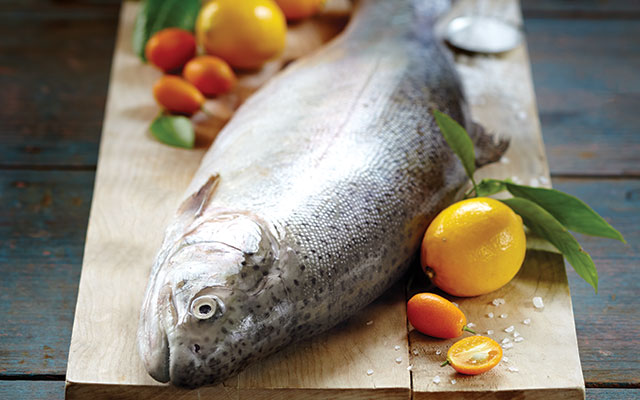
I’ve been writing about local eating, food miles, organics, and the importance of paying attention to our food-distribution system for years and years. But I have to confess that I completely missed this one obvious truth: People who fish have always eaten locally. They can tell you the exact stream or lake where their food emerged. Heck, they can even tell you how much of a fight their food put up.
So how did this fact escape me? I guess it’s because I’m such a born-and-bred city kid: I grew up, for all intents and purposes, in a TV room in New York City. And today, as a restaurant critic, I eat mainly in city restaurants, where most of the fish comes from ocean trawlers.
I’m embarrassed to admit that, until this season, I never had seen — never even heard of — a freshwater fish cookbook. Isn’t that absurd? After all, what’s more local than American streams, lakes and rivers?
The good news is that the errors of my past have been addressed by Chef Lucia Watson’s Cooking Freshwater Fish: 50 Contemporary Approaches to Classic Recipes, which was commissioned by people who also noticed the lack of good freshwater fish recipes, namely the folks at In-Fisherman magazine.
Watson is one of freshwater-America’s preeminent chefs; in fact, as the chef-owner of Lucia’s Restaurant and Wine Bar in Minneapolis, she has repeatedly been nominated for James Beard Foundation Awards as the Best Chef in the Midwest.
In addition to being a big-city chef, Watson is also an avid angler, a passion she developed during childhood summers at her family’s island cabin on Canada’s Rainy Lake.
“When I was growing up, the cabin had no electricity or telephones, and we just spent our summers running around like little wild kids,” Watson told me. “I’d fish with my dad, fish with my grandpa — there were always a ton of people around, and a lot of our life revolved around, ‘Should we go fish for walleye or bass? Crappies? Muskies?’ Or sometimes, just for fun, we’d go fish for northerns.”
When I asked Watson why northern pike were “just for fun,” we hit an obvious city-kid/country-kid divide. I might as well have asked whether it was OK to valet-park my Big Wheel at the latest downtown foodie hotspot. Northern pike, it turns out, is something you would only eat because you had to, not because you really wanted to.
Happily, Watson excels at turning virtually any fish into something you — and definitely I — would want to eat. And though I will likely never take rod-and-reel into hand, I am finding her book invaluable, not least because it offers lots of innovative, deeply flavored catfish recipes.
I’ve known for a few years now that American farm-raised catfish is one of the healthiest, most environmentally conscientious, ethically pure food choices anyone in the Lower 48 can make. Yet just knowing I could eat catfish was doing me little good, since I didn’t have the foggiest idea what to do with the stuff besides fry it in cornmeal.
Watson’s book has changed all that: It features recipes for catfish in a Creole casserole; catfish grilled with sweetcorn sauce; catfish chili-dusted and served with cumin rice; catfish baked under a salsa of fresh tomatoes, jalapeños and garlic, and served with guacamole and refried black beans; catfish in gumbo; and, if that’s not enough for you, catfish as an option in any number of soups or chowders.
I had no idea you could do so much with this most local of inland American fish. That’s too bad, Watson explained — too bad for me and all the other people out there like me.
“Whenever I teach a cooking class, people have so much anxiety about cooking fish,” she said. “They are very fearful about it: ‘Will it be overdone? What if it’s still raw?’” But, Watson explained, classic American recipes like a catfish gumbo or a tomato-basil fish chowder (recipe below) are designed to be all but foolproof.
“I think anyone who has anxiety about cooking fish should try something like a gumbo, and they’ll just be amazed. It’s much easier than cooking a fish. You make everything in one pot, throw the fish in last, put the lid on it, and don’t worry about it.”
Dishes like these are very flexible, Watson explains: “You can reheat them. You can put in seasonal greens or kale, or substitute a vegetable stock for a fish stock, if that’s what you’ve got on hand. You don’t want to boil a gumbo to death, of course, but just put it all on a simmer until you’re ready to eat. In the meantime, crack open a bottle of wine, relax, have some fun, enjoy your company — and enjoy the catch.”
Sounds like some eat-local advice that even a dyed-in-the-wool city kid like me can follow with ease.
Chili-Dusted Catfish With Cumin Rice
Serves two
Ingredients
- Catfish
- 2 tsp. paprika
- 1 tsp. chili powder
- 2 tsp. salt
- 1/2 tsp. cayenne
- 1/4 cup buttermilk (or whole milk)
- 1 egg
- Pinch of sugar
- 2 catfish fillets
- 1/2 cup dry bread crumbs
Directions
- Preheat the oven to 400 degrees F. Lightly grease a cookie sheet.
- Mix together the spices.
- In a shallow bowl, beat together the buttermilk, eggs and sugar.
- One at a time, dip each fillet in the spice mix, then the buttermilk mixture, and finally the bread crumbs.
- Place each fillet on the greased cookie sheet.
- Bake the fish until cooked through, about 12 to 14 minutes. Serve with the cumin rice
Cumin Rice
Ingredients
- 1 tbs. butter
- 1 tbs. minced garlic
- 1 tsp. ground cumin
- 1/2 tsp. dried oregano
- 1 cup long grain rice
- 2 cups chicken stock or water
- 1 tsp. salt
- 1/2 tsp. pepper
- 1/4 cup minced scallion
- 1 tsp. additional butter
Directions
- In a large, heavy-bottomed saucepan, heat the butter until melted.
- Add the garlic, cumin, oregano and the rice. Cook, stirring about three minutes.
- Add the stock, salt and pepper. Bring to a boil, reduce the heat, and cook covered for about 15 minutes, or until the liquid is absorbed and the rice is tender.
- Turn off the rice, and allow it to sit, covered, for about five minutes.
- Stir in the additional butter and scallions, and fluff with a fork.
Sesame-Crusted Trout With Ginger Scallion Salad
Serves two
Ingredients
- Trout
- 1/2 cup lemon juice
- 4 tbs. sesame seeds
- Two 8- to 10-ounce fresh trout, butterflied
- Salt and pepper
- 2 tbs. butter
- 2 tbs. dark sesame oil
Directions
- Dip each trout into the lemon juice. Season with salt and pepper, and then dredge the skinless side in the sesame seeds to coat well.
- In a heavy-bottomed sauté pan, heat the butter and oil until the foam subsides. Place the trout sesame-side down in the pan.
- Lower the heat to medium and cook about 5 to 8 minutes; flip, and cook another 5 to 8 minutes.
Ginger Scallion Salad
Ingredients
- 1/4 cup fresh ginger thinly julienned, about 1-inch long
- 1/2 cup scallion thinly julienned, about 1-inch long
- 1 tbs. soy sauce
- 1 tbs. dark sesame oil
- 1 clove garlic, finely mashed
- Pinch of sugar
- 1 tsp. red pepper flakes
- 1 tbs. orange juice
- 1 tbs. orange zest
- 1 tbs. fresh mint, roughly chopped
- 1 tbs. fresh cilantro, roughly chopped
Directions
- Combine all ingredients and taste for seasoning, adjusting if necessary. Pile a little of the salad on top of each trout.
Tomato-Basil Fish Chowder
Serves four
Ingredients
- 2 tbs. olive oil
- 2 stalks celery, coarsely chopped
- 1 onion, coarsely chopped
- 1 carrot, peeled and coarsely chopped
- 1 medium green bell pepper, chopped
- 1 jalapeño pepper, finely chopped
- 2 cloves garlic, mashed
- 5 to 6 large ripe tomatoes, peeled, cored and chopped (or one 12-ounce can of diced tomatoes)
- 3 to 4 cups chicken broth (depends on how juicy your tomatoes are)
- Salt and pepper
- A splash of balsamic vinegar
- 3 fish fillets (try walleye, crappie, salmon or trout), about 8 ounces each, deboned and cut into 1-inch squares
- A big handful of fresh basil, washed and chopped
- Croutons (make your own with the recipe below)
Directions
- In a large, heavy soup kettle, heat the olive oil and add the celery, onion, carrot, peppers and garlic. Cook over medium heat, covered, for about 10 minutes, stirring occasionally.
- Add tomatoes, broth, salt, pepper and vinegar. Cook over medium heat another 15 minutes.
- Add the fish and simmer gently for eight to 10 minutes, so the fish is cooked but not falling apart.
- Divide the basil into four bowls.
- Ladle the fish soup over the basil and garnish with croutons.
Garlic Croutons
- Cut 1/2 loaf of whole-grain bread into small cubes.
- Generously drizzle with a mixture of olive oil and melted butter, and mix with a couple of cloves of mashed garlic.
- Spread the croutons on a baking sheet and bake for about 10 minutes at 425 degrees F, shaking the pan every few minutes until the croutons are golden brown and crisp.
All recipes excerpted from Cooking Freshwater Fish: 50 Contemporary Approaches to Classic Recipes by Chef Lucia Watson (In-Fisherman, 2006).

This Post Has 0 Comments