




As I write this, the newspapers are on fire with news of the latest economic calamity. I’m trying not to feel too nervous about it, though; I’m looking for inspiration from other cultures that have long done more with less.
Take, for instance, southern Italy, a place so economically challenged for so many generations that its food has become known as cucina povera, the cuisine of poverty. It features mainly plants, but especially tomatoes, beans and hearty greens such as kale that can withstand the combination of blazing sun and chilly nights that mark life in the region’s hills.
Southern Italians eschew expensive black pepper in favor of chili peppers they can grow and use both fresh and dried. They choose younger, less expensive grana padano cheese over the costly, long-aged Parmesan Reggiano. And, when cooking meat or fish, they use lots of olive oil or tomatoes (or both) to stretch the portions and boost the flavor.
All of this penny-pinching resulted in one of the world’s greatest cuisines — one that a new generation of American chefs now turns to for ideas. Nate Appleman is one of those chefs.
Appleman is a rising food star in California, nominated for two James Beard Foundation Awards for his work at his San Francisco restaurants, A16 (named for the highway that cuts across the Italian boot near the ankle) and SPQR (after the official government signature of the ancient Romans). Both of these restaurants look to the simple cucina povera methods of southern Italy for their inspiration.
“I’ve been a frugal person my entire life,” Appleman told me on the phone from San Francisco. “And while I got my start in French kitchens, the hardest part of working in them was just watching how much stuff goes into the garbage. It was just appalling. There are some chefs out there who will cook a whole duck just to get the breast, throw the rest of the duck away and purchase legs from somewhere else.
“Have you ever seen those egg shells filled with baked custard?” Appleman continued. “My wife has a story about walking into a French kitchen and finding a sous chef cracking eggs and throwing the eggs straight into the garbage. ‘I already have the custard,’ he said. ‘I just need the shells.’ That kind of thing just aggravates me, and it would never happen in a true Italian kitchen. In Italy to this day, they don’t put salt in their bread because it was so expensive. Cooking was based on what people caught or had or grew. I find that simplicity really beautiful and exciting.”
Appleman’s new cookbook, A16: Food + Wine (Ten Speed Press, 2008), which he coauthored with the restaurant’s sommelier Shelley Lindgren, interprets the traditional southern Italian cucina povera for modern American cooks. A section of tuna conserva recipes, for instance, illuminates an ingredient I’ve always been curious about: oil-packed tuna.
Appleman explained that preserved tuna arrived “because people didn’t have the luxury of saying, ‘I only want a pound of tuna.’ If you went out and were lucky enough to catch a tuna, you had a whole tuna. The traditional way of storing it was to poach it, salt it and pack it in oil.”
Heavy-metal concerns notwithstanding, canned, oil-cured tuna seems to be something I should rely on more: It’s inexpensive, it’s heart-healthy, and it could sit in my pantry waiting for my inevitable weeknight dinner crisis. Up till now, I’ve just had no idea what to do with it.
At A16, Appleman poaches his own tuna (the recipe is in his book), but he says that cooks can feel free to use good-quality, commercial oil-packed tuna in his recipes. They can combine the tuna with inexpensive ingredients like radicchio and red potatoes or fava beans and dandelion greens for hearty main-course salads. Lots of Appleman’s other recipes are equally budget friendly, relying on inexpensive cuts of meat like pork shoulder (see the featured recipe in the Web Extra! at the top right of this page) and bargain hearty vegetables like kale, chard and carrots.
At a time when financial resourcefulness is top of mind for many, who knew the best economic news of the day would come from a cookbook? At last, some cost-cutting advice that won’t leave a bad taste in your mouth.
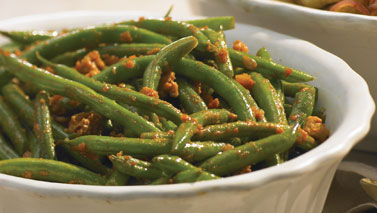
Braised Green Beans With Pork and Soffrito
Serves six
Pork and Tomato Soffrito
- 1 tbs. extra-virgin olive oil
- 1⁄2 red onion, diced (about 1 cup)
- 1 tsp. kosher salt
- 1⁄4 cup tomato paste
- 8 ounces boneless pork shoulder, cut into 1-inch cubes and ground in a meat grinder or finely chopped in a food processor
- 1 cup water
Green Beans
- Kosher salt
- 2 pounds green beans, ends trimmed
- 1 tbs. extra-virgin olive oil
Directions
- To make the soffrito, heat the olive oil in a large pot over medium heat. Add the onion, season with salt, and cook, stirring occasionally, for about three minutes, or until tender. Stir in the tomato paste and continue to cook, stirring frequently, for about two minutes longer, or until the tomato paste changes from bright red to brick red.
- Add the pork, adjust the heat to low, and cook gently, stirring occasionally, for about five minutes, or until the pork has rendered most of its fat and is cooked through. Taste for seasoning and add more salt if needed. Stir in the water and continue to simmer for about five minutes more, or until the mixture is nearly dry. You should have about 11⁄2 cups soffrito.
- Bring a large pot of salted water to boil. Add the green beans and blanch for about five minutes, or until nearly tender. Drain well and lay out the beans on a towel-lined baking sheet. Taste a bean. If it’s underseasoned, add more salt to the beans.
- Give the pot you used for cooking the beans a quick rinse and return it to the stove. Add the olive oil and warm over medium heat. Stir in the soffrito and cook for about three minutes, or until it’s sizzling. Stir in the beans, add a splash of water, adjust the heat to medium-low, and simmer the beans for about six minutes, or until they are soft and have absorbed the flavor of the soffrito. Taste for seasoning and add salt if needed.
- Transfer the beans to a warmed serving bowl and serve immediately.
Arugula Salad With Almonds, Green Olives and Tangerines
Serves six
- 4 ounces arugula
- 3/4 cup green olives, pitted and sliced
- 1/2 cup almonds, toasted and coarsely chopped
- 1/4 cup fennel bulb
- 4 tangerines, peeled and separated into segments
- 1/4 cup extra-virgin olive oil
- 1 tbs. freshly squeezed lemon juice
- Kosher salt
- Freshly ground black pepper
- Block of ricotta salata for grating
Directions
- Place the arugula, olives and walnuts in a large bowl.
- Cut the fennel quarter in half lengthwise, and then cut away the core. Using a mandoline or a sharp knife, shave the fennel lengthwise into paper-thin slices.
- Add the fennel slices and tangerine segments to the bowl, and season the salad with pinches of salt and pepper to taste. Using your hands, toss the salad gently, mixing well.
- Transfer the salad to a large serving bowl.
- Using a Microplane or other fine-rasp grater, grate a generous amount of ricotta salata over the top. Serve immediately.
Roasted Potatoes and Cauliflower With Red Onion, Capers and Chilies
Serves six
- 1 pound Yukon Gold potatoes, similar in size, cut into 1-inch pieces
- Kosher salt
- 1/2 cup extra-virgin olive oil
- 1 head cauliflower (about 2 pounds)
- 1/3 cup salt-packed capers, soaked
- 1/2 teaspoon dried chile flakes
- 1 red onion, sliced
- 3 tbs. red wine vinegar
Directions
- Preheat the oven to 450 degrees F.
- In a large bowl, combine the potatoes with about 1 teaspoon salt and 2 tablespoons of the olive oil and toss to coat the potatoes evenly. Transfer the potatoes to a rimmed baking sheet, spreading them in an even layer. Reserve the bowl for seasoning the cauliflower.
- Roast the potatoes, rotating the pan front to back about halfway through cooking, for about 40 minutes, or until cooked through and golden.
- Meanwhile, remove the core of the cauliflower and separate the head into florets. Cut the largest florets in half, so that all the florets are uniform in size.
- Transfer to the same bowl used to season the potatoes, add about 1 teaspoon salt and 1/4 cup of the olive oil, and toss to coat the florets evenly. The florets must be generously coated with olive oil to brown evenly.
- Heat a large ovenproof sauté pan over high heat. Give the cauliflower a final toss in the bowl and transfer to the sauté pan.
- Using a rubber spatula, scrape any oil remaining in the bowl into the pan.
- Cook the florets, stirring occasionally, for about seven minutes, or until they begin to turn golden brown on the outside but remain firm on the inside.
- Transfer the sauté pan to the oven and roast the florets, stirring them a few times to ensure even cooking, for about 20 minutes, or browned but not completely soft.
- While the potatoes and cauliflower roast, heat the remaining 2 tablespoons olive oil in a small pot over medium heat.
- Pat the capers with a paper towel and carefully add them to the oil (they may splatter). Fry the capers for about two minutes, or until they bloom and become crispy.
- Stir in the chile flakes and onion and cook for three minutes longer, or until the onion softens.
- Stir in the vinegar and remove from the heat. When the potatoes and cauliflower are ready, remove from the oven and let cool slightly before combining.
- Then combine them in a large bowl, add the onion mixture, and toss gently until all of the ingredients are evenly distributed.
- Taste for seasoning and add more salt and vinegar if needed to balance the flavors. Serve hot or at room temperature.
Recipe excerpted from A16: Food + Wine by Nate Appleman and Shelley Lindgren (Ten Speed Press, 2008).
This Post Has 0 Comments